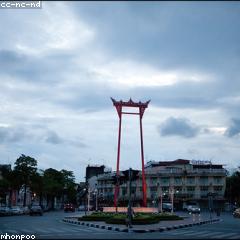
At the heart of Southeast Asia, Thailand is home to a wealth of stunning natural sights, vibrant traditions, rich history, and world-renowned cuisine. As the only Southeast Asian country to have escaped colonization by E…
DEGREE
Required
TYPICAL MONTHLY SALARY
$1,000–$1,500 / month
COST OF LIVING
Low
CAN SAVE MONEY
Yes
HIRING SEASONS
February, March, April, August, September, October, year-round
overview
At the heart of Southeast Asia, Thailand is home to a wealth of stunning natural sights, vibrant traditions, rich history, and world-renowned cuisine. As the only Southeast Asian country to have escaped colonization by European powers, Thailand today is a constitutional monarchy formally known as the Kingdom of Thailand, or Ratcha Anachak Thai by locals. Situated entirely within the tropics, Thailand has a peninsular south jutting into the Andaman Sea and Gulf of Thailand, and is landlocked to the north, nestled snugly against Laos, Cambodia, and Myanmar. Around the world, many fondly refer to Thailand as the “Land of Smiles,” a slogan that succinctly encapsulates the warm hospitality of the Thai people and the picturesque Thai views that are sure to bring a smile to anyone’s face.
History Many historians date Thai history back to the mid-14th century with the Ayutthaya Kingdom — a thriving, cosmopolitan capital of the Siamese kingdom that’s widely agreed to be the precursor of the Thailand we know today. The country officially adopted its modern-day name in 1939, and in the past century has grown to become the second largest economy in Southeast Asia and one of the most popular tourist destinations around the world. In the past decade, Thailand has significantly reduced poverty throughout the country, though it has also experienced political strife — 2005 marked the beginning of years of political upheaval and protests, culminating in a 2014 coup led by Royal Thai Army Gene…
qualifications
Each country has its own requirements and qualifications when it comes to teaching. Some require a bachelor’s degree in any field. In others, you’ll qualify with only a high school diploma and your TEFL certificate. Some countries have strict visa requirements that may disqualify you based on your citizenship or criminal background. Let’s take a look at the qualifications needed for teaching English in Thailand.
Education You will need to possess a 4-year bachelor’s degree in any subject in order to receive your Non-Immigrant B Visa and Thai Work Permit to teach in Thailand.
Citizenship While there are no specific citizenship requirements to teach English in Thailand, schools may specifically prefer to hire those from the United States, Canada, the United Kingdom, Ireland, South Africa, Australia, and New Zealand.
South African applicants, moreover, might be asked to provide proof that their schooling in middle school and high school was conducted in English (letters from the schools should be sufficient proof) and/or a South African Qualifications Authority (SAQA) letter of evaluation.
English Fluency Employers highly prefer to hire native English-speaking teachers, but teachers are not required to be native English speakers in order to teach in Thailand, and non-native English-speaking teachers may have some opportunities there. Non-native English speakers may be required to provide proof of English proficiency through a TOEIC or IELTS score.
Background Check You must …
job types
The demand for English teachers in Thailand continues to grow as the country globalizes its economy to compete with other Southeast Asian countries. Competition for teaching positions in Thailand has been increasing in recent years, however, as the country is saturated with various TEFL and TESOL schools that train and churn out qualified English instructors by the dozens.
Most English teaching jobs in Thailand can be found in government-run public schools or private schools teaching to children or young adults, though there are also possibilities to teach at private language centers in certain parts of the country.
Private Language Schools In Thailand, it is also possible to teach in private language schools, or specialized institutes where students of all ages will go specifically for extra language practice. As a private language school teacher, you will typically work around your students’ school or work schedules, so you can expect to teach classes in the afternoon, evening and weekends. You’ll find that private language schools are most common in larger cities in Thailand such as Bangkok, though there will be some scattered throughout smaller Thai towns as well. As a private language school teacher, you might need to work for at least two different private language schools in order to secure a full-time teaching schedule, which is around 25 – 30 hours per week.
Formal Schools Formal schools, on the other hand, are similar to government-run public schools, but familie…
applying
Now that you’ve explored the job types available to you, it’s time to begin the application process! There are several steps to take to find a job teaching English in Thailand, and we have them all outlined below. Heads up! The timelines for your job application process and for gathering documents for your visa may overlap. You’ll want to be working on both processes at roughly the same time. Be sure to check out our Thailand Timeline , as well as the Applying for the Visa section for more information and to make sure you are staying on top of your visa documents while applying for teaching positions.
Step 1: Prepare Your Initial Application Materials Resume & Cover Letter Your resume and cover letter are the keys to connecting with recruiters and beginning the application process. International employers look for specific elements in a resume that may differ from what you’re used to seeing domestically. Once you’ve updated your resume and cover letter to meet the recommended international standards, submit your drafts to your Student Affairs Advisor for review.
Step 2: Determine Your Preferences A major part of the teaching abroad experience is enjoying where you’ll actually be living! Do you have a preference when it comes to your daily routines and surroundings? Do you want to live in the bustling capital city of Bangkok? Or do you crave a picturesque, small town experience in a city like Phetchaburi? Do you value having greater access to specific types of community more…
accepting
Congratulations on your job offer(s)! If you’ve been offered a position from a school in Thailand and you’ve followed our previous advice, you’re already off to a great start. But what’s next? Determining whether or not the offer is right for you. To help make this decision, follow the recommendations below by reviewing the basics. Whether you have one offer or several, the key elements you’ll want to take note of are: salary, working hours, vacation days, sick days, housing, airfare, insurance, and bonuses. Let’s take a closer look at what to expect with each of these elements. Review the Basics Salary The average starting salary for a first-year English teacher in Thailand is 30,000 – 45,000 THB (Thai Baht) per month. Anything significantly lower or higher should make you ask a few questions. If the reason for the pay difference is obvious, like you’ll be in a rural location with a low cost of living or working longer than average hours, you may find that you’re okay with it. But don’t accept a contract that is paying you less for doing the same amount of work the average English teacher does, or one that doesn’t fit into your work-life-travel balance.
Working Hours Teaching English in Thailand can be a part-time or full-time gig, though the latter is more common. However, there’s more than just the total number of working hours per week (typically 35-40 hours) to consider. Will you have to work in the morning for a few hours and then come back for more in the evening? Doe…
visa
The word “visa” tends to provoke daunting images of endless red tape and paperwork but we’re here to ease your anxiety and hopefully have you zipping through this visa process like a pro. Take it from ITA alumna Sierra D., who taught in Sriracha, “The tourist visa that I obtained in my home country allowed me 90 days in Thailand. Before that time was up, I did a ‘visa run’ to Laos to get my non-immigrant B visa which allowed me another 90 days. I am currently in the process of getting my work permit/teacher license which allows me to stay for one full year. My company has helped me along the entire visa process which I am extremely grateful for, because visas can be complicated, and differ [from] country to country.” Sounds straightforward enough, right? Let’s get started!
Visa Types Non-Immigrant-B Visa What is it? A visa for those who wish to live in Thailand long term, or for those who plan to travel to Thailand for reasons other than tourism. If you want to work in Thailand, for instance, you will need to apply for this Non-Immigrant B Visa. Without the Non-Immigrant B Visa, you won’t be able to apply for a Thai Work Permit. How do you get one? You’ll apply for the Non-Immigrant B Visa from a Thai Embassy or Consulate outside of Thailand. You will need to mail or drop off your passport, as well as any other required visa documents. More details below. How long is it valid? This visa is valid for three months from the day of issuance, and can be issued as a single-entry o…
relocation
In the days, weeks, and months leading up to your move abroad, it’s more important than ever to stay organized and ask yourself: What are the logistics I have to consider and the loose ends I have to tie up in order to thrive in my new home?
Do I have to worry about taxes? What about health insurance? And what the heck do I do about a cell phone? Fear not, TEFL teacher. In this section, you’ll find the tips, resources, and wisdom to tackle these questions and more! Review the Basics Health Insurance Although in a perfect world an apple a day would keep the doctor away, in reality, even teachers get sick. Cue health insurance. Regardless of the country you end up in, you should always inquire about health insurance before accepting a position. If health insurance is indeed provided by your employer, it’s imperative that the relevant details are outlined clearly in any contract you sign. More often than not in Thailand, basic health insurance will be provided by your employer. Depending on your contract, you might have to pay into this insurance and share the cost 50-50 with your school — a small cost that will automatically be deducted from your paycheck. Check out the “Accepting the Right Offer” section to learn more! If health insurance is not included in your contract or if you want to supplement your public health insurance with a more comprehensive private insurance option, you will need to do your own research in order to determine which plan might be the best fit for y…
timeline
You have finally made it to the end of the Thailand section, no small feat! Here is all of that wonderful information from the previous section laid out step-by-step and month-by-month before your intended departure date for Thailand. This timeline is not only for the planners and checklist lovers (although you will love this too!). It is strongly encouraged for anyone planning a move to Thailand to help keep you on track and organized as you make your way through the process. Finding a Job in Advance Please keep in mind that finding a job in advance of arriving in Thailand is certainly possible, though less common than it is to find a job on the ground in Thailand. Use this timeline to nail down your plan of attack, and remember that the peak hiring season for English teaching jobs in government-run public schools or private schools in Thailand is February through April and August through October. On the other hand, jobs in private language schools in Thailand can typically be found year-round, except for major holidays. Take your desired start date and subtract from there. While it may be possible to move some parts of the process along quicker, follow this timeline as closely as possible. 6 months before departure: Begin your research ___ Decide to work with recruiters, apply directly, or both! ___ List out your preferences and priorities ___ Chat with ITA alumni, watch alumni videos, and read about alumni experiences in Thailand ___ Read through ITA’s resources, and watch…
alumni
I work from 8:00 AM to 4:30 PM on the average day. I teach 20 hours of class a week and the rest are office hours. I make about $1,100/month. I can save about $500/month if I am careful and do not travel consistently (which I do). I work for a government school. I teach high school students in grades 10,11, and 12.
For vacation time, teachers get all of March and April off of work. We get one week at the end of October for semester break and there are numerous four day weekends that one can travel to nearby cities.
Stephan S.
Thailand Chiang Mai is said to have one of the biggest expat communities in SE Asia. I personally already knew two girls here from my TEFL course in Cambodia, but we expanded our group through meeting other expats while out and about on the weekends, at the schools we teach at, and also through Facebook groups. Some good Facebook groups to join are the ITA Thailand Alumni group, Teachers of Chiang Mai, Chiang Mai girls, and Chiang Mai Expat Teachers Group (also good places to find schools that are hiring).
Chiang Mai is surrounded by places to see on the weekend that you can drive to or take really cheap buses. I would highly recommend Pai, Chiang Rai, and Doi Inthanon. You can also fly to south Thailand and you will be on the beautiful islands.
Melissa L.
Chiang Mai, Thailand Bangkok is so international you could live the same life you lived in the US here, (if you had a US salary). They have clubs, bars, everything. If you want to live a more loca…